Summits on the Air (SOTA) JA/NR-057 Mt Hatafuriyama is the second most popular summit in the world, following G/SP-015 The Cloud in the UK. To date, the activation count is 2,062.
Hatafuriyama is a Chinese character meaning “flag-waving mountain.” True to its name, flags were waved from the summit of Hatafuriyama. This was a form of communication known as “flag-waving communication.”
During the mid-Edo period (18th century), rice prices in Japan were determined based on the rice market price in Osaka. “Flag-waving communication” was developed to communicate this standard rice price to other regions of Japan.
Rice futures, the world’s first futures product, were developed in Japan. The price of rice futures was communicated from Osaka to other regions via “flag-waving communication” relay points (like Mt Hatafuriyama) located approximately 12 km (7.46 miles) apart.
The image below shows the network of “flag-waving communication”:
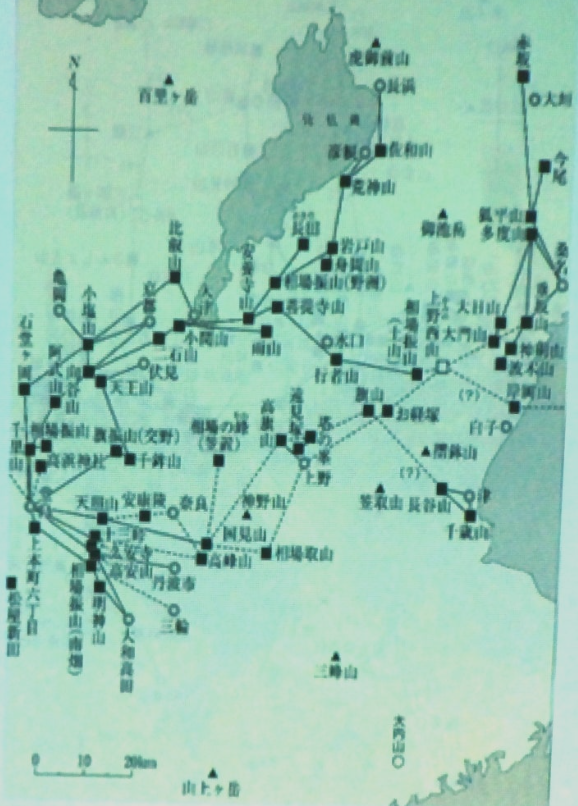
Using this “flag-waving communication,” rice futures prices were reportedly transmitted at a speed of 720 km/h (447 mph) between Dojima, Osaka and Fushimi, Kyoto.
On rainy or other bad weather days when the flags were not visible, people would run to convey the rice price.
However, with the introduction of the telephone in 1893, “flag-waving communication” was gradually replaced by the telephone, and by 1918 it had been completely abandoned.
Mt Hatafuriyama is located in an area that makes it easy to communicate from the large city of Osaka, and has now enjoyed a revival as a popular mountain for mobile amateur radio operation as SOTA JA/NR-057.
Comments